Two lenders both offer you 500,000 over five years at “8 percent”. One loan costs you 108,291.83 in interest. The other costs 200,000. Same number on the poster, a gap of 91,708.17 in your pocket. The difference is how the rate is applied, and it is the first thing worth checking before you sign any loan, car financing or instalment plan.
What a flat rate means
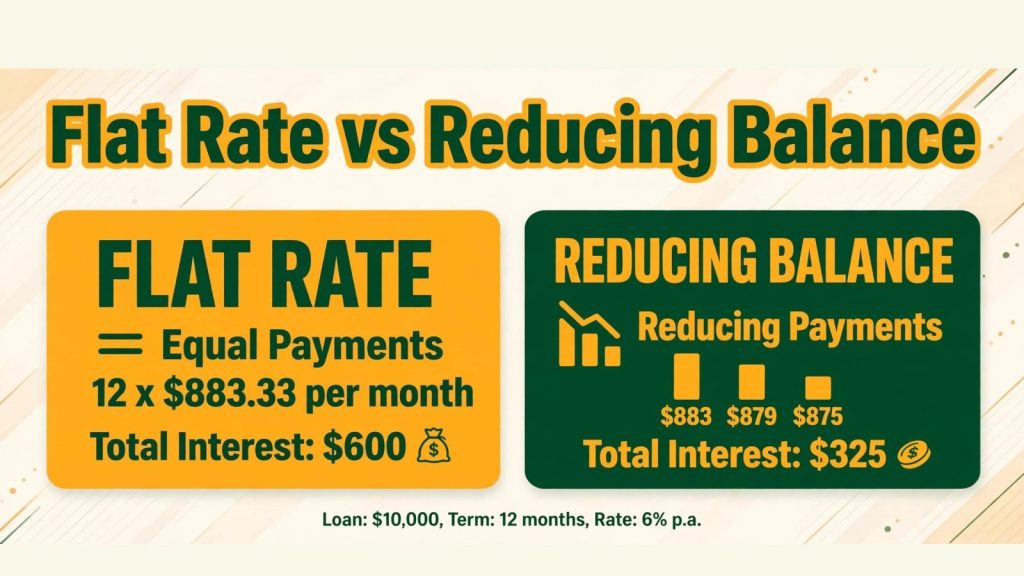
A flat rate charges interest on the original amount for the whole term, however much you have already repaid. The calculation is simple: amount x rate x years. On 500,000 at 8 percent flat for 5 years, the interest is 500,000 x 0.08 x 5 = 200,000. Add that to the principal and divide by the number of months: 700,000 / 60 = 11,666.67 a month.
Notice what that means month by month. Every instalment carries 8,333.33 of principal and 3,333.33 of interest, from the first payment to the last. Your balance keeps falling, but the interest part never does.
What a reducing balance rate means
A reducing balance (also called declining balance) rate charges interest only on what you still owe. Each month the interest is the current balance times the monthly rate, and the rest of the instalment pays down the principal. This is the standard amortising loan, and it is the method behind a normal EMI formula.
On the same 500,000 at 8 percent reducing for 60 months, the monthly rate is 8 / 12 = 0.6667 percent. The EMI is 10,138.20. In month one, 3,333.33 goes to interest and 6,804.86 to principal. Next month the interest is a little lower because the balance is lower, and it keeps shrinking until the last payment.
The same loan, side by side
| 500,000 for 60 months | 8% flat | 8% reducing |
|---|---|---|
| Monthly payment | 11,666.67 | 10,138.20 |
| Total repaid | 700,000.00 | 608,291.83 |
| Total interest | 200,000.00 | 108,291.83 |
| Interest in month 1 | 3,333.33 | 3,333.33 |
| Interest in month 60 | 3,333.33 | about 67 |
Month one looks identical, which is why the two offers can feel the same in a sales conversation. The gap opens later, because the reducing loan charges interest on a balance that is shrinking and the flat loan does not.
How to find the real rate behind a flat quote
To compare a flat offer with a bank loan quoted on a reducing balance, you need the reducing rate that produces the same monthly payment. There is no tidy formula for it, but a spreadsheet does it in one line. For the flat example above:
=RATE(60, -11666.67, 500000) * 12
That returns about 14.13 percent a year. So an 8 percent flat loan over 5 years behaves like a 14.13 percent reducing balance loan. A second example: 300,000 over 36 months at 10 percent flat gives a payment of 10,833.33, which matches a reducing rate of about 17.92 percent. The same 300,000 at 10 percent reducing would have a payment of 9,680.16.
In both examples the real rate is roughly 1.8 times the flat rate. Treat that as a rough check only, because the exact figure depends on the term, and always confirm it with a calculator or the RATE function.
Questions to ask before you sign
- Is the quoted rate flat or reducing balance? If the lender says “markup” or “per annum on the principal”, ask directly.
- What is the total amount I will repay over the whole term? This one number makes any two offers comparable.
- Are there processing fees, insurance or early repayment charges, and are they included in the figures you quoted?
- If I repay early, is interest recalculated on the remaining balance, or do I still owe the flat interest?
Check your own numbers
Put your loan through the Loan EMI Calculator to get the reducing balance payment, then use the Loan Interest Calculator to see total interest and what extra payments would save. The Simple Interest Calculator shows the flat-rate side: it applies the rate to the original amount, which is how a flat quote is built. For a vehicle purchase, the Car Loan Calculator works the same way.
This article is for general information, not financial advice. Figures are rounded to two decimals and ignore fees, taxes and insurance. Your loan agreement is the final word on how interest is charged.