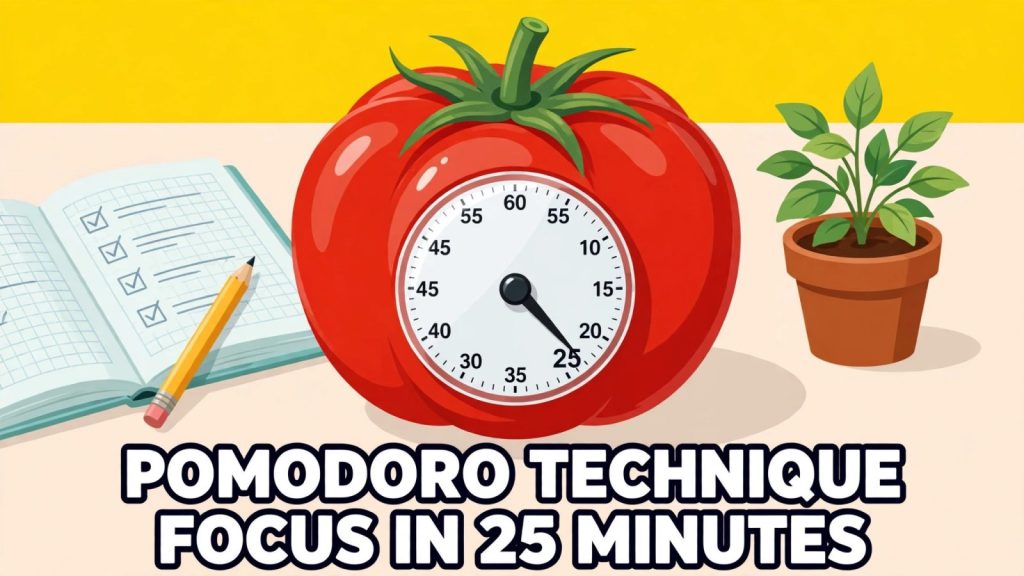
Twenty-five minutes. That is the whole trick. Pick one task, set a timer for 25 minutes, and work on nothing else until it rings. Then take a five-minute break, and do it again. The method is called the Pomodoro Technique, and it is searched for about 110,000 times a month on Google, while “pomodoro timer” adds another 74,000 searches a month (SEMrush, October 2026). The most popular timer site in the space, pomofocus.io, pulled 4.52 million visits in October 2026 alone. People are not looking for a complicated system. They are looking for a way to start.
This guide explains the technique exactly as its creator designed it, shows what the research actually says, and gives you a plan for your first day. If you want to try it right now, our free Pomodoro Timer runs the 25-minute sessions, the short breaks and the long break for you, with a task list beside the timer and a count of your completed sessions.
What Is the Pomodoro Technique?

The Pomodoro Technique is a time management method developed by Francesco Cirillo in the late 1980s. Cirillo was a university student who could not concentrate on his studies. He challenged himself to focus for just a few minutes at a time, using a tomato-shaped kitchen timer to keep himself honest. “Pomodoro” is Italian for tomato, and the name stuck. He started with blocks of about ten minutes and lengthened them as his focus improved, until he settled on 25 minutes as the standard session.
Each 25-minute block of work is called one pomodoro. The original technique has six steps, and they are worth learning properly before you start changing them:
- Decide on the task to be done.
- Set the timer, typically for 25 minutes.
- Work on the task, and nothing else, until the timer rings.
- When the timer rings, put a checkmark on a piece of paper and take a short break of five minutes.
- Go back to step two and repeat until you have completed four pomodori.
- After four pomodori, take a longer break of 15 to 30 minutes, then start a new set.
Cirillo published his book about the method in the 1990s, and it was updated and revised in 2013 and again in 2018. The creator and his supporters encourage a low-tech approach: a mechanical timer, paper and a pencil. The physical act of winding the timer confirms your decision to start, the ticking reminds you that you are working, and the ringing announces the break. Apps and websites have since popularised the technique, and it has been adopted in contexts as different as studying, writing and pair programming, but the core idea has not changed: one task, one timer, one short burst of full attention.
The planning matters as much as the timer. Before you start, you write a “To Do Today” list and estimate each task in pomodori. As you finish each session you record it. That record is what turns a kitchen timer into a planning tool: after a week you know how many pomodori a report, a chapter or a bug fix really takes, and you stop guessing.
The 25-5 Rule: How One Full Cycle Works
The rhythm is 25 minutes of work, five minutes of break, repeated four times, then a long break. Here is what one full cycle looks like in numbers:
| Part | Length | What you do |
|---|---|---|
| Work session (1 pomodoro) | 25 minutes | One task, full attention, no switching |
| Short break | 5 minutes | Step away from the task completely |
| Four pomodori | 100 minutes of work | Four sessions plus three 5-minute breaks |
| Long break | 15 to 30 minutes | A real rest after the fourth pomodoro |
| One full cycle | 130 to 145 minutes | 100 minutes of focused work in about two hours |
Two rules make the method work, and both are easy to break. First, a pomodoro is indivisible: it cannot be split or shortened. If you are interrupted, you have two honest choices. Either record the interruption and postpone it, using the inform, negotiate, schedule and call back strategy Cirillo describes, or abandon the pomodoro entirely and start a fresh one. What you must not do is pause the timer and pretend the interruption never happened, because then the timer stops meaning anything.
Second, if you finish a task while the pomodoro is still ticking, the pomodoro still has to ring. Use the remaining minutes to review what you did, improve it, or note what you learned. Cirillo calls this overlearning, and it is the difference between rushing to the next task and actually finishing the one in front of you.
Run the numbers for a full workday and the method looks less like a trick and more like a budget. Eight pomodori give you 200 minutes of focused work, which is 3 hours and 20 minutes. With seven short breaks and one long break, the whole day takes 250 to 265 minutes, or about 4 hours and 10 to 25 minutes. That is the honest trade: you do not get eight hours of focus from eight hours at your desk. You get a little over three hours of real focus, protected by breaks, and the rest of the day is meetings, email and admin. Our free Pomodoro Timer counts your sessions and your focused minutes as you go, so you can see that budget instead of guessing it.
What the Research Actually Says

The Pomodoro Technique is popular, but popularity is not proof. Here is what the published research actually found, including the parts that are less flattering.
The most cited study is from the University of Illinois. In 2011, Atsunori Ariga and Alejandro Lleras published a paper in the journal Cognition, “Brief and Rare Mental Breaks Keep You Focused”. They asked 84 people to do a repetitive computer task for about 50 minutes. Most people’s performance declined steadily over the task, which is the normal pattern for sustained attention. But one group was given two brief breaks, a short switch to a different small task, and their performance did not drop at all over the whole 50 minutes. The researchers concluded that briefly deactivating and then reactivating your goal keeps you focused, and that prolonged attention to a single task actually hinders performance. It is a small lab study on a simple task, not proof that 25 minutes is a magic number, but it is real evidence that scheduled breaks protect attention.
A more direct test came in 2023. Researchers at Maastricht University compared 25 students studying with the Pomodoro Technique against 35 students taking self-regulated breaks. The students who chose their own breaks took longer study sessions, and that was associated with higher fatigue and lower concentration and motivation. The study found no difference between the two groups in mental effort or in how much work they completed. In other words, the Pomodoro group felt less tired and more focused, but did not finish more. That is a useful, honest result: the method may make hard work feel easier without making you faster.
The newest evidence is a scoping review published in October 2025 in BMC Medical Education, looking at the Pomodoro Technique and anatomy lesson retention during study sessions. It concluded that “time-structured Pomodoro interventions consistently improved focus, reduced mental fatigue, and enhanced sustained task performance, outperforming self-paced breaks.” A scoping review is not a single experiment, it is a summary of the studies available, and the field is still small. But the direction is consistent: fixed breaks beat breaks you take whenever you feel like it, because you rarely take those breaks at all.
What the research does not say matters too. No study proves that 25 minutes is better than 20 or 30 for everyone. The number comes from Cirillo’s own trial and error, not from a brain scan. Treat 25 as a starting point, not a law, and change it only after a full week of honest use.
How to Run Your First Pomodoro Day
Do not buy anything and do not install anything. You need a timer, a pen and a piece of paper. Here is a first day that actually works, using our free Pomodoro Timer if you would rather not watch a kitchen clock.
- The night before, or first thing in the morning, make your list. Write down the three to five tasks that matter today, and estimate each one in pomodori. A short email is one pomodoro. A first draft of a report might be four. If a task needs more than five or six pomodori, break it into smaller pieces first.
- Clear the desk. Close every tab except the one you need. Put your phone in another room, or at least face down and out of reach. Tell anyone nearby that you are working in 25-minute blocks and will be free at the next break.
- Pick the first task and start the timer. Say out loud, or write down, what the pomodoro is for: “Draft the introduction, 25 minutes.” Then work on that and nothing else until the timer rings.
- When the timer rings, stop. Put a checkmark next to the task, stand up, stretch, get water, look out of a window. Do not check your phone or your email. Five minutes is short on purpose: it is a rest, not a new activity.
- Repeat until you have four checkmarks, then take the long break. Fifteen to thirty minutes. Eat something, take a walk, do something genuinely different. This is the break that makes the second half of the day possible.
- Handle interruptions with the rule, not with guilt. If someone interrupts you, note it on your paper, tell them you will come back to it, and return to the task. If the interruption cannot wait, abandon the pomodoro, deal with it, and start a fresh 25 minutes afterwards. Do not restart the clock from where you stopped.
- At the end of the day, look at your checkmarks. How many pomodori did you complete? How many did interruptions kill? Write one line about what you will change tomorrow. That review, done daily, is where the method pays off.
Here is what an eight-pomodoro morning looks like, starting at 9:00 with a 30-minute long break:
| Time | What happens |
|---|---|
| 9:00 – 9:25 | Pomodoro 1 |
| 9:25 – 9:30 | Short break |
| 9:30 – 9:55 | Pomodoro 2 |
| 9:55 – 10:00 | Short break |
| 10:00 – 10:25 | Pomodoro 3 |
| 10:25 – 10:30 | Short break |
| 10:30 – 10:55 | Pomodoro 4 |
| 10:55 – 11:25 | Long break (30 minutes) |
| 11:25 – 13:20 | Pomodori 5 to 8, with short breaks between them |
The 52/17 Rule and Other Variations Worth Trying
Twenty-five minutes is the default, not a law of nature. The most famous alternative comes from DeskTime, a time-tracking company. In 2014 it analysed its most productive users, the top 10 percent by its productivity rating, and found they worked for an average of 52 minutes and then took a 17-minute break. The finding became known as the 52/17 rule, and it was widely reported, including by Fast Company and The Muse. DeskTime later re-ran the analysis: during the pandemic the pattern stretched to 112 minutes of work and 26 minutes of break, and using 2024 data from about 6,000 top-rated users it found a 75/33 ratio. The ratio keeps moving, which is the point: these are observations about how productive people happened to work, not proof that one ratio causes productivity. Still, 52/17 is worth trying if 25 minutes feels too short for your work, especially for writing and coding, where getting started takes time.
Other variations are simpler. The 50/10 split is the Pomodoro with a doubled work block, and it suits people who lose momentum when they stop every 25 minutes. The 90/20 split is popular for deep work, with a 90-minute session and a 20-minute break, though 90 minutes of unbroken focus is hard to hold more than once or twice a day. Flowtime is a different idea altogether: you work until you reach a natural stopping point, note how long that took, and then take a break proportional to the work, roughly a fifth as long. It suits creative work where stopping mid-sentence costs more than it saves.
The honest way to choose is to test one variation for a full week and count your completed sessions. A method that gives you six real sessions a day beats a perfect method you abandon by Wednesday. If you need custom intervals, our free Timer Tool lets you set any length you like, and the Pomodoro Timer keeps the classic 25-5 rhythm with the long break built in.
7 Mistakes That Kill the Method

Most people who say the Pomodoro Technique does not work for them are making one of these seven mistakes. None of them is hard to fix.
1. Skipping the breaks. The break is not a reward for finishing early, it is part of the method. The Illinois study found that brief breaks are what keep performance from declining. If you work through the break, you are just working in 50-minute blocks with a timer that lies to you.
2. Checking your phone during the break. A five-minute break spent scrolling is not a break from stimulation, it is a different kind of stimulation. Cirillo’s rule is that the break must be fully disconnected from the task. Stand up, stretch, drink water, look out of the window. Your brain needs the change, not a new feed.
3. Splitting a pomodoro. Pausing the timer to answer a message and then resuming it destroys the whole point, which is that the timer is a promise. Either the interruption waits, or the pomodoro is abandoned. There is no third option.
4. Starting without a plan. If you sit down, start the timer and then decide what to do, you will spend the first ten minutes deciding. The “To Do Today” list exists so the pomodoro starts with work, not with planning. Plan first, then time.
5. Using it for the wrong tasks. The method fits single tasks with a clear end: writing, studying, coding, admin. It fits meetings badly, because a meeting does not stop when your timer rings. It also fits creative flow work badly when you are already deep in it; if you are writing well at minute 25, finishing the paragraph before you stop is common sense, not cheating, but do not make it a habit.
6. Counting pomodori instead of doing the work. Ten pomodori of shallow, distracted work are worse than four honest ones. The checkmark is a record, not a score. If you catch yourself starting easy tasks just to fill the count, you have the method backwards.
7. Quitting after one bad day. The first day feels strange for everyone. The timer interrupts you, the breaks feel too short, and you keep reaching for your phone. That is the habit you are trying to break, not proof the method fails. Give it a full working week before you judge it, and change only one thing at a time.
Pomodoro for Students, Writers and Coders
The same 25 minutes work differently for different jobs, so here is how to fit the method to yours.
Students. The technique was invented by a student, and studying is still its best use. Break revision into topics, one pomodoro per topic, and use the short break to move, not to scroll. Students who want more free tools for their coursework should look at our roundup of the best free AI tools for students, and teachers who want to run timed study sessions for a class can borrow ideas from our guide to the best free AI tools for teachers. Four pomodori of revision with real breaks beats an evening of staring at a textbook.
Writers. Writers love the method because a blank page stops being a whole afternoon and becomes one 25-minute block. Set a word target per pomodoro rather than a time target: if you write 400 words in a session, four pomodori give you 1,600 words, which is a solid chapter or a full essay draft. Use the break to step away from the screen, not to edit what you just wrote. Editing belongs in its own pomodoro, with fresh eyes. If you need to check how long your draft is, our free Word Counter guide explains the word counts essays, exams and applications actually expect.
Coders. The technique has been adopted in pair programming, where one person writes code while the other reviews, and they swap roles each pomodoro. On your own, one pomodoro fits one small, complete job: a single function, one bug, one test. Long debugging sessions are where the method earns its keep, because a forced break is often when the answer appears. If a problem needs more than four pomodori, break it down before you start, or the timer will keep catching you mid-thought.
Frequently Asked Questions
Is 25 minutes the only option?
No. Twenty-five minutes is the default Cirillo settled on, and it is the best place to start, but the research does not prove it is better than 20 or 30 minutes for everyone. Use 25 minutes for a full week first. If your work genuinely needs longer to get going, try 50 minutes with a 10-minute break, and count your completed sessions for a week before you decide.
Does the Pomodoro Technique work for ADHD?
Many people with ADHD find that an external timer and a short, clear deadline make starting easier, because the task becomes “work for 25 minutes” instead of “finish the whole project”. That is a common experience, not a medical claim. The technique is not a treatment for ADHD or any other condition, and if focus is a serious problem, a doctor or a specialist is the right person to ask.
What do I do if I get interrupted in the middle of a pomodoro?
Write the interruption down, tell the person you will come back to it, and keep working. That is the inform, negotiate, schedule and call back strategy. If the interruption cannot wait, abandon the pomodoro completely and start a fresh 25 minutes when you are free. Never pause the timer and resume it later.
Can I use the Pomodoro Technique for studying?
Yes, it was designed for studying. One pomodoro per topic, a short break between topics, and a long break after four. The 2023 Maastricht study found that students using fixed Pomodoro breaks reported less fatigue and better concentration than students who chose their own break times, although they did not finish more work.
How many pomodori should I do per day?
Six to eight is a realistic target for deep work. Eight pomodori give you 200 minutes of focused work, which is 3 hours and 20 minutes. Beginners should aim for four and build up. More than ten in a day usually means the sessions were not honest, or the breaks were skipped.
The Pomodoro Technique is not magic, and the research is honest about that: it makes hard work feel easier and keeps your attention from sliding, but it does not write the essay for you. What it does, better than almost any other method, is make starting easy. One task, one timer, 25 minutes. Start your first session now with our free Pomodoro Timer, and count your checkmarks at the end of the day. That count is the only review that matters.
Facts in this article were checked on 21 November 2026 against Wikipedia, Duke University, EBSCO, the University of Illinois, PubMed, DeskTime and SEMrush.