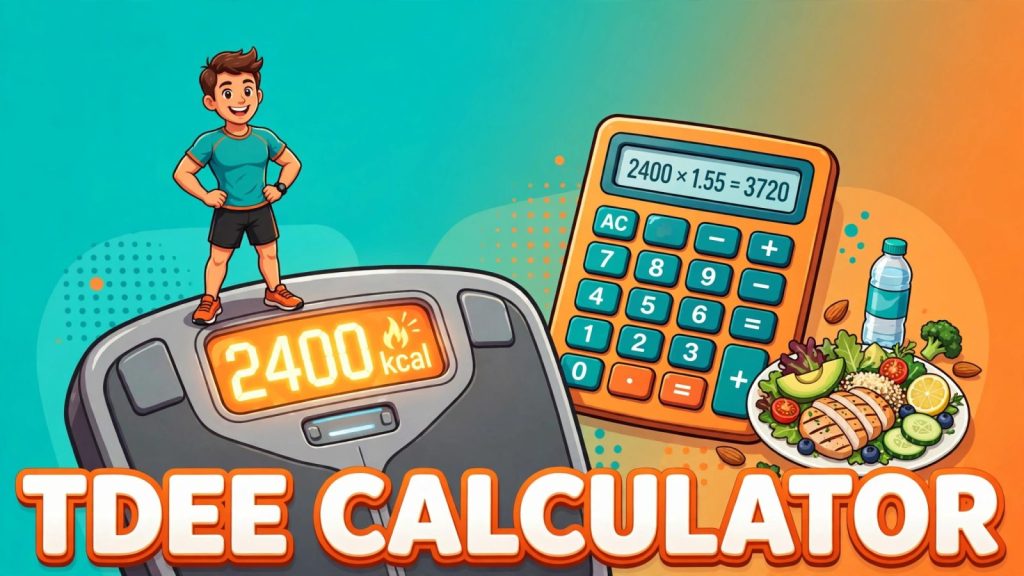
Every diet, every workout plan and every “eat this many calories” tip starts from the same number: how many calories your body actually burns in a day. That number has a name, TDEE, and once you know yours, the guesswork stops. You can work it out in two minutes with our Free TDEE Calculator, and this guide shows you exactly how the number is built, what it means, and how to use it without falling for the usual mistakes.
All facts, formulas and figures in this article were checked on 17 November 2026 against two or more independent sources. Calorie figures are estimates for healthy adults, not medical advice.
What TDEE actually is

TDEE stands for Total Daily Energy Expenditure. It is the total number of calories your body burns in 24 hours, and it covers everything: keeping your heart beating and your body warm while you sleep, digesting your lunch, walking to the bus stop, and your evening workout. If you eat exactly your TDEE every day, your weight stays roughly the same. Eat below it and you lose weight. Eat above it and you gain.
That is why TDEE is the starting point for almost every weight plan. A diet that tells you to eat 1,200 calories means nothing on its own, because 1,200 calories is a big deficit for someone whose TDEE is 2,800 and barely a deficit at all for someone whose TDEE is 1,500. The number only makes sense once it is measured against your own burn.
The important thing to understand is that TDEE is not a fixed number printed on your body. It moves. It rises when you gain muscle or start training, falls when you lose weight or sit all day, and drifts down slowly as you age. A good TDEE figure is a snapshot of your life right now, and it deserves a recalculation every few months.
The four parts of your daily burn
Your TDEE is not one thing. It is four kinds of burning added together, and knowing the split explains why two people of the same size can have very different calorie needs.
BMR, your basal metabolic rate, is the biggest slice, roughly 60 to 70 percent of your TDEE. This is the energy your body uses at complete rest just to stay alive: breathing, circulating blood, keeping your organs running and your body temperature steady. You burn it even if you never leave the bed. BMR depends mostly on your size, age and sex, and muscle burns more than fat, which is why two people at the same weight can have different BMRs.
NEAT, non-exercise activity thermogenesis, is usually 15 to 20 percent. This is all the movement that is not a workout: walking around the house, standing at your desk, climbing stairs, fidgeting, carrying shopping bags. Research published in the Journal of Internal Medicine found that NEAT alone can vary by up to 2,000 calories a day between two people of the same size, which is why a postman and a desk worker with identical bodies can need wildly different amounts of food.
EAT, exercise activity thermogenesis, is the deliberate training slice, roughly 5 to 10 percent for most people. An hour in the gym burns a few hundred calories, which sounds like a lot until you compare it with the 1,400 or so your body burns at rest. Exercise matters enormously for health, muscle and appetite, but as a calorie burner it is the smallest lever for most people, and that surprises almost everyone.
TEF, the thermic effect of food, is about 10 percent. Digesting food costs energy, and protein costs the most to process, followed by carbohydrate, then fat. You cannot change TEF much, but it is one reason high-protein meals feel more filling for the same calories.
Put together, BMR plus NEAT plus EAT plus TEF equals your TDEE. No calculator measures these four directly. Instead, a calculator estimates your BMR from your body and multiplies it by an activity factor that stands in for the other three. That two-step method is how almost every TDEE calculator on the internet works, including ours.
How to calculate your TDEE step by step

Calculating your TDEE takes two steps. First you find your BMR with the Mifflin-St Jeor equation, then you multiply it by an activity factor. The equation was published in 1990 by Mark Mifflin, Sachiko St Jeor and colleagues, after measuring the resting metabolism of 498 healthy adults, and a 2005 systematic review found it the most reliable of the common equations for both normal-weight and obese adults. The Academy of Nutrition and Dietetics recommends it as the most accurate formula for healthy adults.
For men, the formula is: BMR = (10 x weight in kg) + (6.25 x height in cm) – (5 x age) + 5. For women, it is: BMR = (10 x weight in kg) + (6.25 x height in cm) – (5 x age) – 161. If you weigh yourself in pounds and measure height in feet and inches, convert first: divide pounds by 2.2 to get kilograms, and multiply total inches by 2.54 to get centimetres. Or skip the arithmetic entirely and let our Free TDEE Calculator do both steps for you in seconds.
Here is a worked example. Take a 30-year-old woman who weighs 65 kg and is 165 cm tall. Her BMR is (10 x 65) + (6.25 x 165) – (5 x 30) – 161, which is 650 + 1,031.25 – 150 – 161, or about 1,370 calories a day at rest. She exercises moderately, three to five days a week, so her activity factor is 1.55. Her TDEE is 1,370 x 1.55, which is about 2,124 calories a day. That is her maintenance level: eat around 2,124 calories and her weight should hold steady.
And a second example, for a man. A 38-year-old man weighing 80 kg at 180 cm tall has a BMR of (10 x 80) + (6.25 x 180) – (5 x 38) + 5, which is 800 + 1,125 – 190 + 5, or 1,740 calories. If he is lightly active, with light exercise one to three days a week, his factor is 1.375, giving a TDEE of about 2,393 calories a day. Two people, two very different numbers, and both took less than a minute to work out.
One honest warning before you trust any number: these formulas are estimates, and they are usually accurate within about 10 percent for most healthy adults. A 2024 validation study in Scientific Reports, which compared prediction equations against doubly labelled water, the gold-standard measurement, found that fewer than half of adults landed within 10 percent of their measured expenditure. That does not make the equations useless. It makes them a starting point, not a verdict, and the fix is simple: use your TDEE for two to four weeks, watch what your weight actually does, and adjust from there.
Picking the right activity multiplier
The activity multiplier is where most TDEE calculations go wrong, because it is the one input you choose yourself, and most people choose one level too high. The five standard multipliers are 1.2 for sedentary, 1.375 for lightly active, 1.55 for moderately active, 1.725 for very active, and 1.9 for extra active. Moving up one level adds 200 to 300 calories a day to your result, so an honest choice matters more than a precise BMR.
Sedentary, at 1.2, means a desk job, driving everywhere, and little or no structured exercise, usually under 5,000 steps a day. Lightly active, at 1.375, means light exercise one to three days a week, like walking, yoga or a casual gym session. Moderately active, at 1.55, means moderate exercise three to five days a week, or an active job with 8,000 or more steps a day. Very active, at 1.725, means hard exercise six to seven days a week. Extra active, at 1.9, means a physical job plus daily training, or twice-daily sessions.
Be honest with yourself here. If you sit at a desk all day and go to the gym three times a week, you are lightly active, not moderately active. The gym is three hours of your week; the other 165 hours are what the multiplier really describes. When in doubt, pick the lower level and adjust later from real results. It is far easier to add 200 calories after two weeks of losing weight too fast than to undo a month of eating 200 calories too many.
Your step count is a useful reality check. If your phone says you average 4,000 steps a day, you are sedentary no matter how hard your workouts feel. If it says 12,000, you can fairly claim the higher level. Steps do not capture everything, but they stop the most common self-deception in one glance.
Turn your TDEE into a calorie target

Knowing your TDEE is only useful once you turn it into a target. The rule is simple: your TDEE is your maintenance intake, and your goal decides the offset. To maintain your weight, eat at your TDEE. To lose weight, eat below it. To gain weight or build muscle, eat above it.
For fat loss, a deficit of 250 to 500 calories a day below your TDEE is the standard recommendation, and it works out to roughly 0.25 to 0.5 kg (about half a pound to a pound) a week, because a kilogram of body fat stores around 7,700 calories. A 500-calorie daily deficit adds up to about 3,500 calories a week, which is roughly a pound of fat. Start with 250 if you are close to your goal weight, 500 if you have more to lose, and never drop below about 1,200 calories a day for women or 1,500 for men without professional guidance, because very low intakes make it hard to get enough nutrients.
For muscle gain, a surplus of 250 to 500 calories a day above your TDEE, combined with resistance training and enough protein, is the usual starting point. A bigger surplus mostly adds fat, not muscle, so the slow route wins here too. Protein matters as much as calories: most guidance suggests around 1.6 grams of protein per kilogram of body weight a day for people training to build muscle.
A practical way to split your calories is to think in macros. A common balanced starting split is around 30 percent protein, 40 percent carbohydrate and 30 percent fat, though the best split is the one you can actually stick to. What matters most is the total: hit your calorie target consistently, get enough protein, and the exact ratio is a detail you can tune later. Our Free TDEE Calculator gives you maintenance, weight-loss and weight-gain targets in one result, so you can see all three numbers side by side before you choose.
One more thing the target cannot do: it cannot tell you what to eat. Two diets at 2,000 calories can feel completely different. One built on vegetables, lean protein and whole grains keeps you full for hours. One built on biscuits and sugary drinks leaves you hungry by mid-morning. Same calories, very different result, which is why the number is a budget, not a meal plan.
Why your TDEE changes (and when to recalculate)
Your TDEE is a moving target, and the main reason is weight itself. Every kilogram you lose lowers your BMR, because there is less of you to maintain, and it also lowers the energy cost of moving around. Someone who loses 10 kg can see their TDEE fall by 150 to 250 calories a day. That is why a diet that worked brilliantly in month one stalls in month three: the target stayed the same, but the body it was calculated for did not.
Age moves it too, slowly. BMR falls by roughly 1 to 2 percent per decade after early adulthood, mostly because muscle mass declines. It is a small effect year to year, but over a decade it adds up to a real difference, and it is one more reason to keep resistance training in your routine as you get older: muscle is the part of your body that keeps burning.
Activity changes are the fastest-moving factor. A new job that puts you on your feet all day, an injury that keeps you on the sofa, a holiday, a new sport: any of these can move your TDEE by hundreds of calories within a week. As a rule, recalculate your TDEE whenever your weight changes by 5 to 10 kg, when your job or training routine changes, or every two to three months if you are actively working toward a goal. If you also track your weight, our BMI Calculator gives you a quick second number to watch alongside your calories, and our guide to what your BMI number actually means explains how the two figures fit together.
Common mistakes that make TDEE wrong
The first mistake is the one already covered: picking an activity level that flatters you. It is the single biggest source of error in any TDEE estimate, bigger than the formula itself. Pick the level that matches your ordinary week, not your best week.
The second mistake is using the wrong weight. Weigh yourself first thing in the morning, after using the bathroom and before eating, and use a weekly average rather than a single day, because daily weight can swing by a kilogram or more from water, salt and food volume. A number taken after a big dinner will inflate your TDEE and your targets with it.
The third mistake is treating the result as exact. TDEE calculators are usually accurate within about 10 percent, which for a 2,000-calorie TDEE means the true value could be anywhere from 1,800 to 2,200. That range is bigger than most deficits, so the only way to know your real number is to test it: eat at your calculated target for two to four weeks, track your weight honestly, and adjust by 100 to 200 calories at a time until your weight moves the way you want.
The fourth mistake is forgetting that food labels and tracking apps have errors of their own. Labels are allowed a margin of error, restaurant portions are guesswork, and most people under-report what they eat by 20 percent or more without realising it. If your weight is not moving at a calculated deficit, the most likely explanation is not a broken metabolism but an extra snack that never got logged.
The fifth mistake is chasing the number every day. Your TDEE is a weekly average, not a daily prescription. A heavy training day and a rest day do not need different targets unless you enjoy that level of detail. Pick one daily target from your weekly TDEE, eat to it most days, and let the average do the work.
Frequently asked questions
What is a good TDEE for weight loss? There is no single good number. A good weight-loss target is your TDEE minus 250 to 500 calories a day. For most adults that lands somewhere between 1,500 and 2,500 calories, depending on size, age, sex and activity. Use the calculator above, take 500 off the result, and adjust after two weeks of real data.
How accurate is a TDEE calculator? Usually within about 10 percent for most healthy adults, when your activity level is entered honestly. The biggest error comes from overestimating activity, not from the formula. Treat the result as a starting point and refine it with two to four weeks of tracking.
What is the difference between BMR and TDEE? BMR is what you burn at complete rest, just staying alive. TDEE is BMR plus everything else: daily movement, exercise and digestion. TDEE is always higher than BMR, and it is the number you actually eat against.
Should I eat back the calories I burn exercising? Usually not, because your TDEE already includes your exercise through the activity multiplier. Adding workout calories on top double-counts them. The exception is a very long session, like a multi-hour hike, where a modest extra snack makes sense.
Does TDEE change as I lose weight? Yes. Losing weight lowers both your BMR and the cost of moving, so your TDEE falls. Recalculate every 5 to 10 kg lost, or whenever your weight plateaus for more than three weeks at a steady intake.
Is the Mifflin-St Jeor equation the best one? For most healthy adults, yes. Published in 1990 and validated against the older Harris-Benedict equation in a 2005 systematic review, it is the formula the Academy of Nutrition and Dietetics recommends. The Katch-McArdle equation can be more accurate if you know your body-fat percentage, but most people do not, so Mifflin-St Jeor is the practical default.
The bottom line
Your TDEE is the one number every calorie plan depends on. Work it out with the Mifflin-St Jeor equation, pick your activity level honestly, and you will have a maintenance figure you can trust within about 10 percent. Subtract 250 to 500 calories to lose weight, add the same to gain it, then test the number against reality for two to four weeks and adjust. That is the whole system, and it beats every fad diet precisely because it is boring, measurable and yours.
Run your own numbers now with our Free TDEE Calculator: it takes your age, height, weight and activity, gives you your BMR and TDEE, and shows your maintenance, weight-loss and weight-gain targets in one place, free, with no signup and nothing leaving your browser.