If you are trying to get pregnant, or simply want to understand your body better, knowing when you ovulate changes everything. The problem is that most of what people are told about ovulation is wrong: ovulation does not always happen on day 14, a period-tracking app is often wrong, and a single positive test strip does not guarantee an egg was released. This guide explains how to track ovulation properly, with the real numbers behind the fertile window, the signs your body gives you, and a free Ovulation Calculator that does the maths for you in seconds. All facts and figures in this article were checked on 18 November 2026.
What ovulation actually is (and why “day 14” is a myth for most people)
Ovulation is the moment one of your ovaries releases a mature egg into a fallopian tube. That egg then has roughly 12 to 24 hours to meet sperm. If it does not, it breaks down, hormone levels fall, and your period starts about two weeks later. The whole cycle then begins again.
The “day 14” rule comes from the textbook 28-day cycle: ovulation on day 14, period on day 28. The trouble is that a 28-day cycle is an average, not a rule. The NHS says regular cycles anywhere from 21 to 35 days are normal, and your own cycle length can shift by a few days from month to month. In a 24-day cycle, ovulation usually lands around day 10. In a 35-day cycle, it is closer to day 21. Counting forward from your last period only works if you already know your luteal phase, the stretch from ovulation to your next period, and that is the part most people never measure.
Here is the key insight that every good calculator is built on: the luteal phase is far more consistent than the first half of the cycle. It lasts about 14 days for most people, and the NHS puts the usual range at 10 to 16 days before the next period. The follicular phase before ovulation is the part that stretches or shrinks. That is why the reliable way to estimate ovulation is to count backwards from your next expected period, not forwards from your last one.
How an ovulation calculator works
An ovulation calculator needs just two inputs: the first day of your last period and your usual cycle length. From those it works out three things. First, your next period: last period start plus your cycle length. Second, your likely ovulation day: next period minus 14 days. Third, your fertile window: the five days before ovulation plus ovulation day itself.
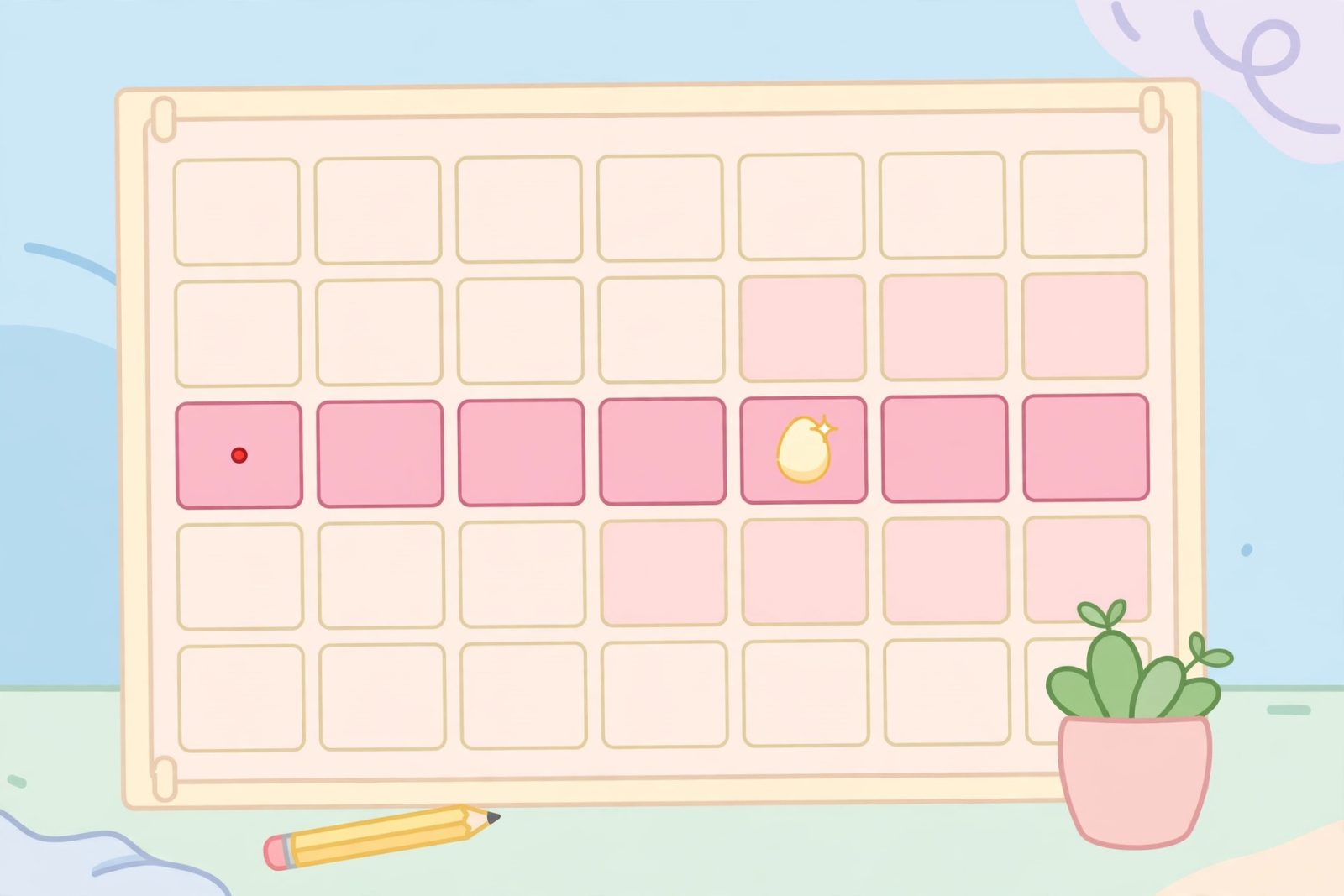
Here is what that looks like for the most common cycle lengths. Day 1 is always the first day of your period.
| Usual cycle length | Likely ovulation day | Fertile window |
|---|---|---|
| 21 days | Day 7 | Days 2 to 7 |
| 24 days | Day 10 | Days 5 to 10 |
| 26 days | Day 12 | Days 7 to 12 |
| 28 days | Day 14 | Days 9 to 14 |
| 30 days | Day 16 | Days 11 to 16 |
| 32 days | Day 18 | Days 13 to 18 |
| 35 days | Day 21 | Days 16 to 21 |
A worked example makes it concrete. Say your last period started on 1 November and your cycle is usually 28 days. Your next period is due on 29 November. Count back 14 days and ovulation lands around 15 November, with a fertile window from 10 to 15 November. With a 32-day cycle starting on the same date, the next period would be due on 3 December, ovulation around 19 November, and the fertile window from 14 to 19 November. Our Ovulation Calculator runs the same calculation for you, shows a colour-coded fertility calendar, and forecasts the next six cycles so you can plan ahead, all in your browser with nothing uploaded or stored.
One warning about the input: use your average cycle length, not your last cycle alone. If your last three cycles were 27, 29 and 28 days, enter 28. A single unusual month, after illness, travel or stress, can throw the estimate off by several days. Three months of notes give a far steadier average than one.
Your fertile window, day by day: the real odds
You can only get pregnant on about six days in each cycle: the five days before ovulation and ovulation day itself. That is not a guess. It comes from the landmark study by Wilcox, Weinberg and Baird, published in the New England Journal of Medicine in 1995. They followed 221 women trying to conceive across 625 menstrual cycles, pinpointed the actual day of ovulation in each cycle with daily urine hormone tests, and recorded which days couples had intercourse. All 192 pregnancies in the study came from intercourse inside that six-day window. Not one came from intercourse after ovulation day.
The study also measured the chance of pregnancy from intercourse on each single day of the window. The odds climb as ovulation approaches:
| Day relative to ovulation | Chance of pregnancy from intercourse that day |
|---|---|
| 5 days before (D-5) | About 10% |
| 2 days before (D-2) | About 27% |
| 1 day before (D-1) | About 31% |
| Ovulation day (D0) | About 33% |
| Day after ovulation (D+1) | About 0% (no pregnancies observed) |
Two things about this table surprise most people. First, the peak is on ovulation day itself, at about 33%, with the two days before it nearly as high. A later re-analysis of the same data by Dunson and colleagues in 1999, which corrected for small errors in dating ovulation, put the peak on the day before ovulation instead, but the message is the same: the three days from two days before ovulation through ovulation day carry roughly three times the odds of the first day of the window. Second, the window is lopsided. It sits before ovulation, not after it, because sperm can survive in the reproductive tract for up to five days waiting for an egg, while the egg itself is viable for less than a day. That is why timing intercourse before ovulation matters more than timing it on the day.
Frequency matters too. An American Society for Reproductive Medicine committee opinion, drawing on the same body of research, reports a per-cycle pregnancy rate of about 37% with daily intercourse during the fertile window, about 33% with intercourse every other day, and about 15% with intercourse once a week. You do not need to time every day perfectly; every other day across the window gets you almost the same result, with far less pressure.
The signs your body gives you
A calculator gives you a date range. Your body gives you live signals, and they arrive at different moments. Learning to read them turns a calendar estimate into something you can trust. There are three signals worth knowing.
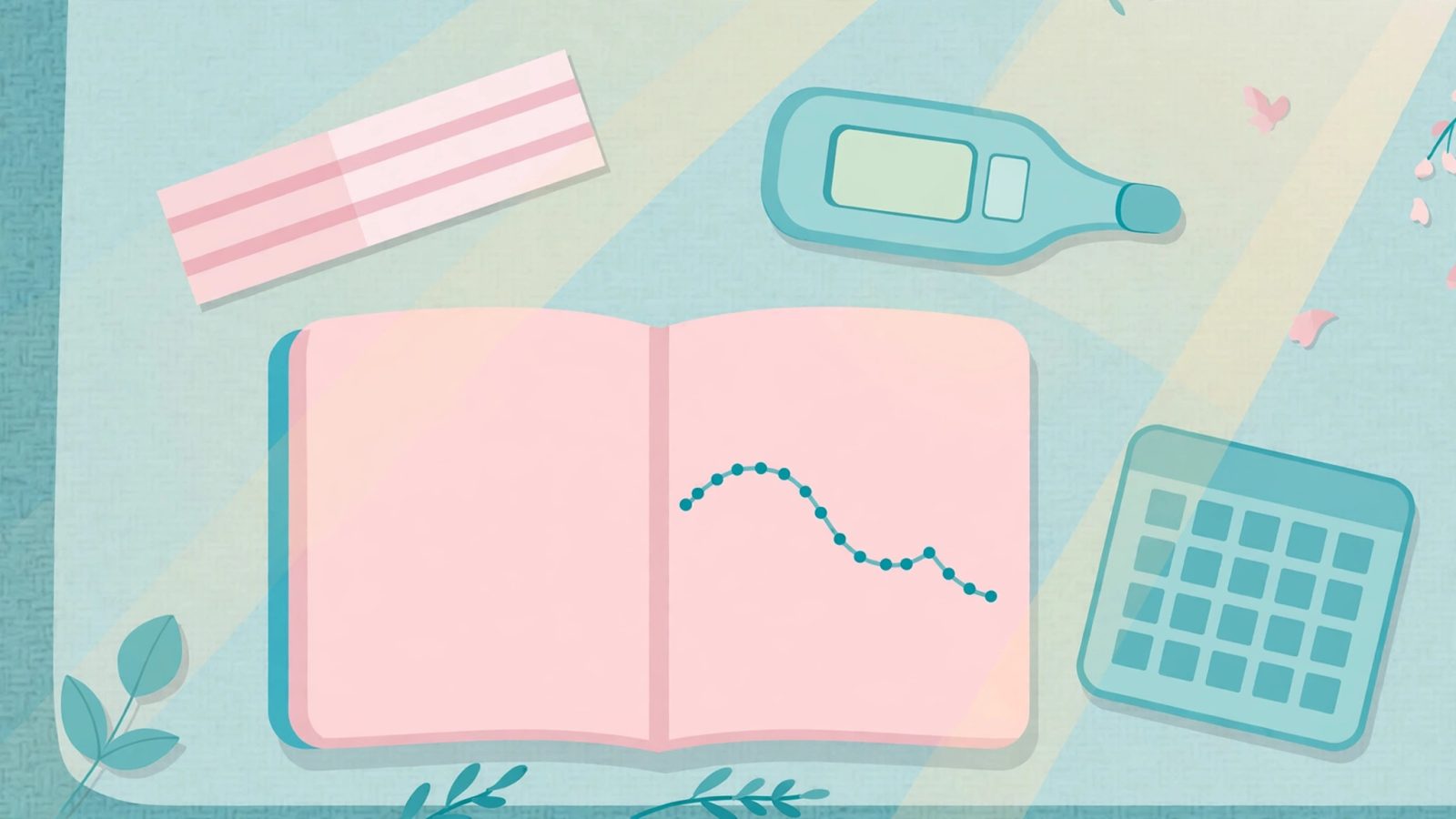
The LH surge. Luteinizing hormone is the trigger that tells the ovary to release an egg. It spikes sharply shortly before release: ovulation typically follows the start of the surge by about 24 to 36 hours, and ovulation predictor kits detect the surge in urine about 24 hours before ovulation. A positive test strip therefore means ovulation is likely within the next day or two, which is exactly the time for intercourse. Test around the same time each day, starting a few days before your expected fertile window. One caution: if you have polycystic ovary syndrome (PCOS), LH can stay raised through the whole cycle, giving repeated positive tests without ovulation.
Cervical mucus. In the days before ovulation, cervical mucus turns clear, slippery and stretchy, like raw egg white. The Cleveland Clinic describes this change as showing up shortly before ovulation. It is your body’s way of helping sperm travel, and it is one of the earliest signs the window is opening. When the mucus dries up again, the window is closing.
Basal body temperature (BBT). Your resting temperature rises after ovulation, because progesterone resets your body’s thermostat. Flo puts the rise at 0.4 to 1 degree Fahrenheit, and the Cleveland Clinic at about 0.5 to 1 degree. The catch is timing: the rise only appears after the egg is already released, so BBT confirms ovulation in hindsight rather than predicting it. Take your temperature first thing every morning, before getting up, with a sensitive thermometer. After a few months you will see a pattern showing when ovulation tended to happen, which sharpens your calculator’s estimate for the next cycle. Other signs some people notice include a small rise in sex drive, mild one-sided twinge pain (mittelschmerz), and tender breasts, but these vary a lot and are not reliable on their own.
The strongest approach is to combine signals. An LH strip tells you ovulation is coming, mucus confirms the window is open, and a sustained BBT rise a few days later confirms it happened. No single signal is perfect; together they are far more trustworthy than any one alone.
How to track ovulation step by step
Here is a simple routine that works for most people with fairly regular cycles. It takes five minutes a day at most, and it costs nothing beyond a pack of test strips if you choose to use them.
Step 1: Record three cycles. Note the first day of each period for three months and work out your average cycle length. This is the number your calculator needs. If you do not have three months of notes, start with your best guess and update it as you go.
Step 2: Run the calculator. Enter the first day of your last period and your average cycle length into our free Ovulation Calculator. It shows your likely ovulation day, your six-day fertile window with the per-day chances from the Wilcox study, and a forecast for the next six cycles. You can also export the dates to your calendar so you do not have to remember them.
Step 3: Start test strips early. Begin ovulation predictor kits about three days before the start of your predicted fertile window, and test daily at the same time. A positive result means ovulation is likely within 24 to 36 hours.
Step 4: Watch your mucus. From the start of the fertile window, check for clear, stretchy, egg-white mucus. When it appears, you are in your most fertile days.
Step 5: Confirm with temperature. Keep taking your basal temperature each morning. A rise that stays up for three or more days confirms ovulation happened. Compare the confirmed day with the calculator’s prediction: if it is consistently a day or two earlier or later, adjust your cycle length or luteal phase for next month.
Repeat this for two or three cycles and you will know your own pattern far better than any app could guess. Most people find their ovulation day falls within a two-day range once they have a few months of data.
What makes ovulation calculators wrong
Calculators are estimates, and honest ones say so. The calendar method assumes a regular cycle and a luteal phase of about 14 days. When those assumptions break, the estimate breaks with them. Here are the main reasons a prediction can be off.
Irregular cycles. If your cycle swings between 24 and 35 days, the next period’s date is itself uncertain, and that uncertainty carries straight into the ovulation estimate. The Cleveland Clinic describes another calendar method for this situation: over six months, subtract 18 from your shortest cycle and 11 from your longest. With cycles of 27 and 32 days, your fertile days would be about day 9 to day 21, a much wider window, and honestly that is the best a calendar can do. With very irregular cycles, LH strips and BBT tracking matter far more than any date calculation.
Apps are often wrong. A 2018 study by Johnson, Marriott and Zinaman found that cycle apps got the day of ovulation right at most 21% of the time. The reason is simple: most apps predict from cycle length alone, using the same calendar maths, and they cannot see your hormones. Treat any app’s single predicted day as a rough guide, not a fact, and cross-check it with a test strip or your temperature.
PCOS and other conditions. Polycystic ovary syndrome can cause high LH all cycle, which makes test strips unreliable, and can cause cycles with no ovulation at all. Thyroid problems, high prolactin, very low body weight and intense exercise can also delay or stop ovulation. If your cycles are regularly shorter than 21 days or longer than 35 days, or you often go months without a period, a calculator cannot fix that; a doctor can find out why.
Stress, illness and travel. The first half of the cycle is sensitive to stress, illness, jet lag and big changes in sleep or exercise. Any of these can push ovulation later by several days in a single month, even in someone with usually regular cycles. If a cycle feels unusual, trust the test strips and your body over the calendar that month.
Can you use an ovulation calculator to avoid pregnancy?
No, and this is important. A calendar estimate is not reliable contraception. The fertile window is six days wide, sperm survive for up to five days, and ovulation can shift by several days without warning. The apps that claim to predict safe days get the day wrong most of the time, as the 2018 study above showed. Natural family planning methods that are actually used for contraception combine daily temperature, mucus and calendar rules with strict training, and even those need careful, consistent use. If you want to avoid pregnancy, talk to a doctor or pharmacist about methods that do not depend on predicting ovulation. Our calculator is built for people trying to conceive or learning their cycle, and it should never be used as birth control.
When to see a doctor
Most couples conceive within a year of trying, but not everyone, and waiting too long can cost precious time. The American Society for Reproductive Medicine recommends a fertility evaluation after 12 months of regular, unprotected intercourse if the woman is under 35, and after 6 months if she is 35 or older. For women over 40, evaluation should start straight away, without waiting. Do not wait at all if you have irregular or absent periods, known endometriosis, a history of pelvic infection or surgery, repeated pregnancy loss, or a known sperm problem. Both partners should be checked from the start: a semen analysis for the male partner runs in parallel, not later.
That advice is not for a rare few. The World Health Organization estimates that about one in six people of reproductive age experience infertility at some point in their lives, so seeking help is common and normal, not a last resort. The first tests are usually simple: blood tests to confirm ovulation, a pelvic scan, and a semen analysis. Many causes are treatable, and the earlier they are found, the more options you have. Weight also plays a role in ovulation: both very low and very high body weight can disrupt cycles, so if that applies to you, our free BMI Calculator can show where you stand, and our guide to what your BMI number actually means explains the healthy range in plain language.
Frequently asked questions
How accurate is an ovulation calculator? For regular cycles it usually lands within a day or two of the real ovulation day, but it is an estimate, not a measurement. Cycle apps got the day right at most 21% of the time in a 2018 study. Pair the calculator with LH test strips and temperature tracking for the best accuracy.
How many days after your period do you ovulate? It depends on your cycle length. Ovulation happens about 14 days before your next period, so in a 28-day cycle it is around day 14, in a 24-day cycle around day 10, and in a 32-day cycle around day 18. Subtract 14 from your cycle length to find your likely day.
Can you get pregnant 5 days before ovulation? Yes. Sperm can survive for up to five days in the reproductive tract, and the Wilcox 1995 study found about a 10% chance of pregnancy from intercourse five days before ovulation. The odds rise to about 27% two days before, 31% one day before, and 33% on ovulation day itself.
Does a positive ovulation test mean you will ovulate? Usually, but not always. A positive LH test means the surge that triggers ovulation has started, and ovulation normally follows within 24 to 36 hours. The surge does not guarantee release, and with PCOS, high LH can give positive tests without ovulation. A sustained temperature rise afterwards is the best home confirmation.
How long is the fertile window? About six days: the five days before ovulation plus ovulation day itself. No pregnancies in the Wilcox study came from intercourse after ovulation day, because the egg is viable for less than a day.
Can stress delay ovulation? Yes. Stress, illness, travel and big changes in sleep or exercise can push ovulation later by several days, because the first half of the cycle is sensitive to disruption. If a cycle feels unusual, trust test strips and your body’s signals over the calendar that month.
Tracking ovulation is a skill, not a single test. Start with the calendar maths, check it against your body’s signals, and confirm it with your temperature, and within two or three cycles you will know your own pattern. If you are ready to find your dates, try our free Ovulation Calculator now: enter the first day of your last period and your usual cycle length, and it shows your fertile window, your likely ovulation day and a six-cycle forecast in seconds, with nothing to sign up for and nothing uploaded. If you have been trying for 12 months under 35, or 6 months at 35 or over, without success, book a doctor’s appointment: that is the recommended next step, not a reason to worry.