Body Mass Index, or BMI, is the most searched health number on the internet. The phrase “bmi calculator” attracts around 7 million Google searches a month worldwide, with the United States alone averaging about 3.3 million a month, according to third-party keyword estimates checked in November 2026. Yet most people who type their height and weight into a calculator get a single number and stop there, with no idea what it actually says about them.
This guide closes that gap. You will learn how BMI is calculated, what each category means, how to work out your own healthy weight range, and where the number stops being useful. And if you want the number first, you can check yours in seconds with our free BMI calculator, which works in metric and imperial units, shows your WHO category and your healthy weight range, and saves your history on your own device.
What BMI actually measures
BMI is a simple ratio: your weight divided by your height squared. It does not measure body fat directly, and it was never designed to diagnose anything. It is a screening tool, a quick way to sort adults into broad weight categories so that doctors, researchers and public health programmes can spot who might need a closer look.
The idea is nearly 200 years old. Belgian mathematician Adolphe Quetelet published the formula in the 1830s, originally to describe the “average man” in population statistics, not to judge any one person’s health. The formula sat mostly unused by medicine for over a century until American physiologist Ancel Keys tested it against real body fat measurements in a landmark 1972 study of more than 7,400 men, found it was the best simple proxy available, and gave it the name we use today: body mass index. The World Health Organization then adopted the standard adult cut-offs in 1995, and they are still the global reference today.
That history matters because it explains both the strength and the weakness of BMI. It is cheap, instant and consistent, which is why it is used everywhere. But it is also a population tool being asked to do a personal job, and that is where most misunderstandings begin.
How to calculate your BMI
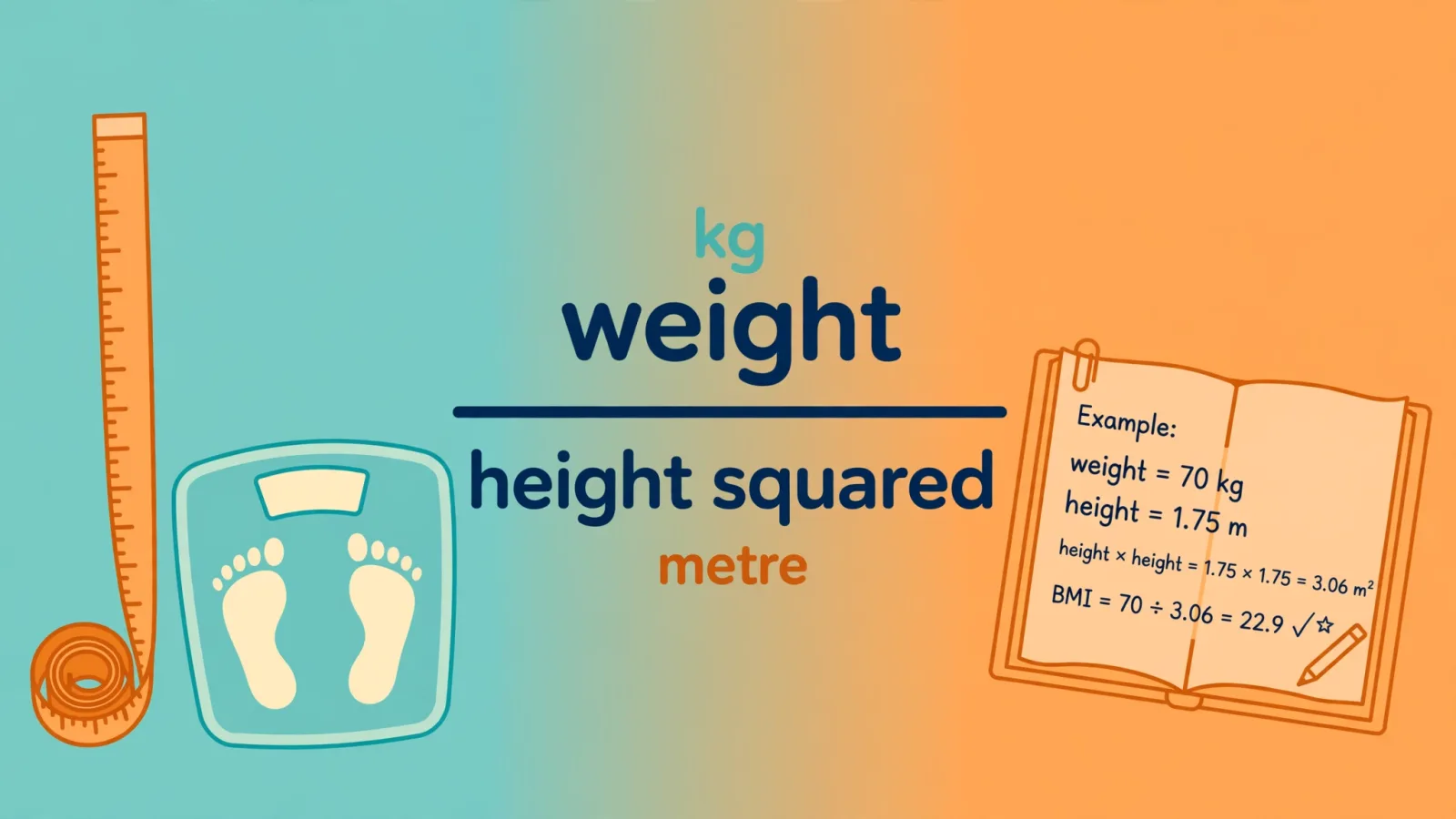
In metric units the formula is straightforward:
BMI = weight in kilograms divided by height in metres squared.
Take a person who weighs 70 kg and is 1.75 m tall. First square the height: 1.75 x 1.75 = 3.06. Then divide: 70 / 3.06 = 22.9. That is a BMI of 22.9.
In imperial units the formula needs one extra constant because pounds and inches do not line up neatly:
BMI = 703 x weight in pounds divided by height in inches squared.
Take a person who weighs 180 lb and is 5 feet 9 inches tall, which is 69 inches. Square the height: 69 x 69 = 4,761. Then 703 x 180 = 126,540, divided by 4,761 = 26.6. That is a BMI of 26.6.
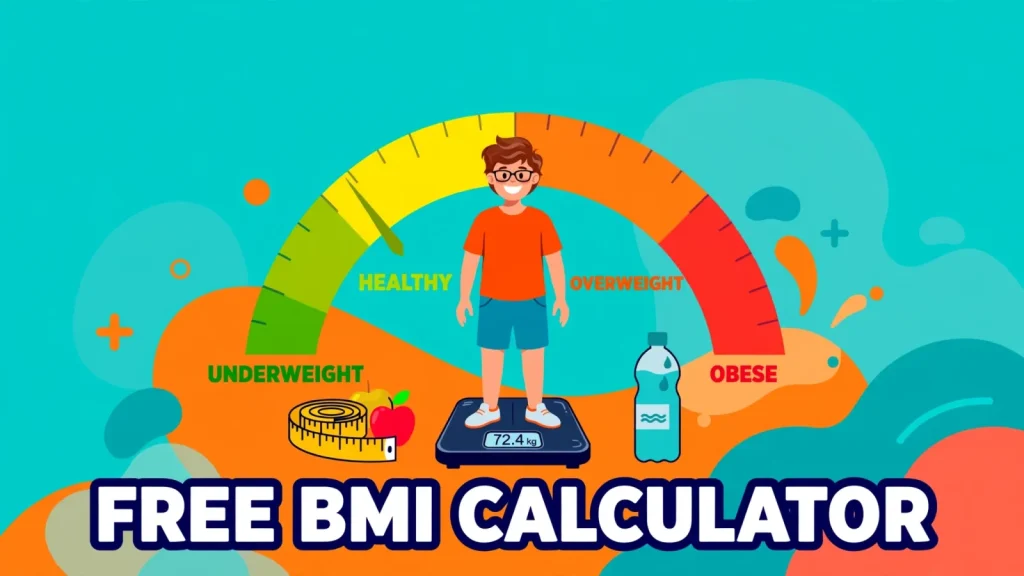
You do not need to do this by hand. Our free BMI calculator handles both unit systems, shows the result on a colour gauge and works out your healthy weight range at the same time, with no signup and nothing leaving your browser.
What your BMI number means
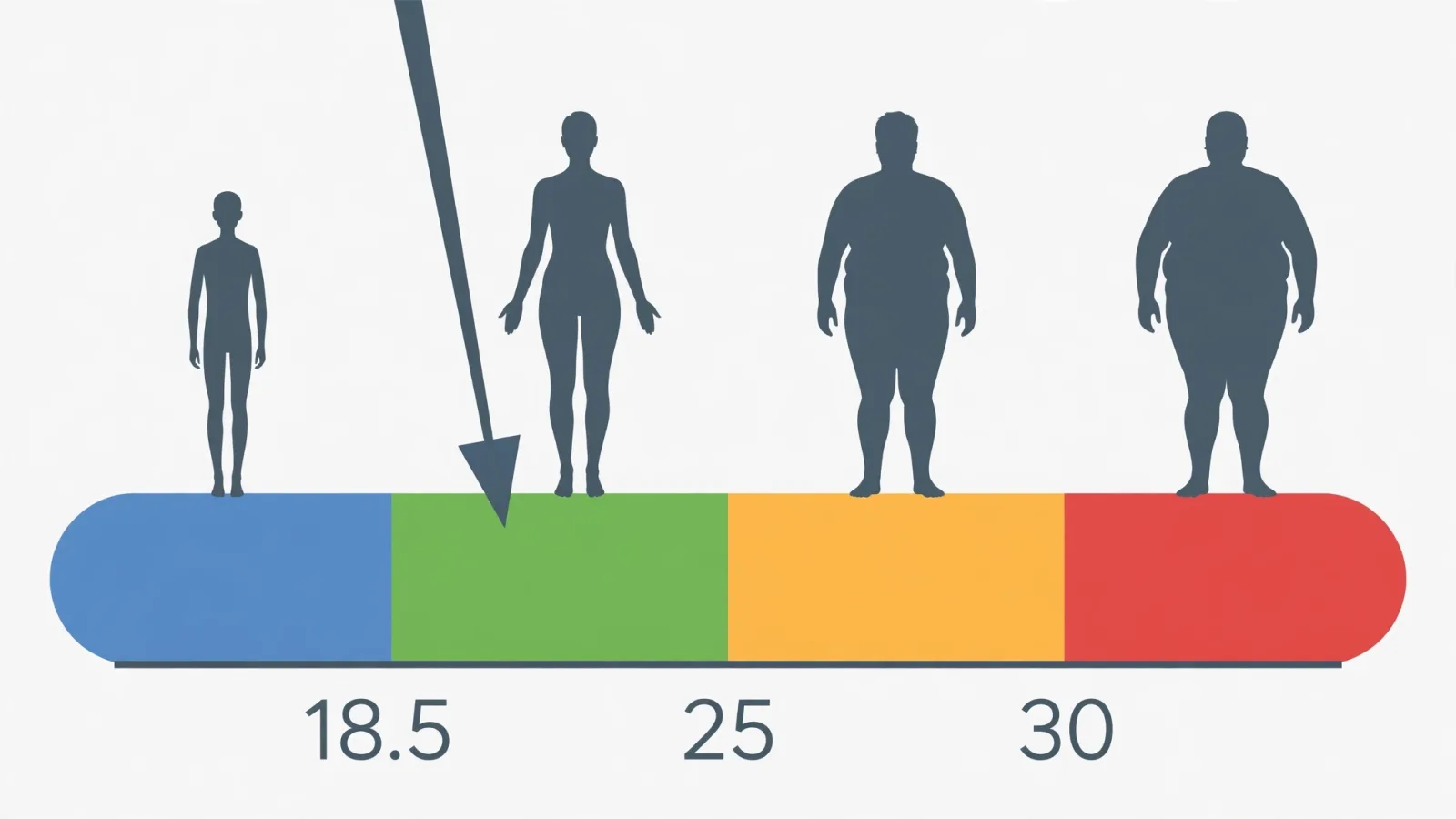
The World Health Organization and the CDC use the same adult categories for men and women aged 20 and over:
| BMI | Category | What it generally means |
|---|---|---|
| Below 18.5 | Underweight | Weight may be too low for your height. Nutrition and possible underlying causes are worth checking. |
| 18.5 to 24.9 | Healthy weight | Associated with the lowest health risk at population level. |
| 25.0 to 29.9 | Overweight | Weight is high for your height, and the risk of some conditions starts to rise. |
| 30.0 to 34.9 | Obesity class I | Moderately increased health risk. Lifestyle changes and medical advice are recommended. |
| 35.0 to 39.9 | Obesity class II | High health risk. A structured plan with a doctor is advisable. |
| 40.0 and above | Obesity class III | Very high health risk. A medical evaluation is strongly recommended. |
Two things about this table surprise most people. First, the boundaries are statistical lines drawn on a gradual slope. The difference between a BMI of 24.9 and 25.1 carries no real clinical meaning, even though one is labelled healthy and the other overweight. Risk rises smoothly as BMI rises, so a number just over a line is not a sudden emergency, and a number just under one is not a clean bill of health.
Second, the categories describe risk across large groups, not a verdict on you. Two people with the same BMI of 27 can have very different health, depending on where they carry their weight, how active they are and what their blood pressure, blood sugar and cholesterol look like. BMI is the start of the conversation, never the whole of it.
How to find your healthy weight range
Your healthy weight range is simply the range of weights that puts your BMI between 18.5 and 24.9 at your height. You can work it out with the same formula, run backwards:
Lowest healthy weight = 18.5 x height in metres squared. Highest healthy weight = 24.9 x height in metres squared.
For a person who is 1.75 m tall, that gives 18.5 x 3.06 = 56.7 kg at the low end and 24.9 x 3.06 = 76.3 kg at the high end. So the healthy range is roughly 57 to 76 kg. For a person who is 5 feet 9 inches tall (1.75 m), the same range is about 125 to 169 lb.
A range is more useful than a single target weight because healthy bodies vary. Where you sit inside the range depends on your build, your muscle mass and your own history. Someone who has always been lightly built may feel best near the lower half, while a naturally broad or muscular person may sit comfortably near the upper half.
If you want a fuller picture of your body composition, pair your BMI with our body fat percentage calculator, which estimates body fat from simple measurements and puts the number in context alongside your BMI.
What BMI cannot tell you
BMI has real limits, and knowing them stops the number from misleading you.
It cannot tell muscle from fat. Muscle is denser than fat, so a fit, muscular person can have a BMI over 25 while carrying very little body fat. Rugby players, weightlifters and many athletes land in the overweight band on paper while being among the healthiest people in the room. The same blind spot works the other way: an older adult who has lost muscle can have a “healthy” BMI while carrying too much fat.
It does not account for age, sex or pregnancy. The adult cut-offs apply from around age 20, but body composition changes with age, and the same BMI means something different at 25 than at 70. The categories are not used for children at all, and they do not apply during pregnancy. Children need age and sex based BMI percentiles, which is why a separate tool exists for them.
It does not account for ethnicity. The WHO cut-offs were developed mainly from European populations, and health risks can appear at lower BMIs in some groups. The WHO describes additional public health action points of 23 for overweight and 27.5 for obesity in some Asian populations, and several countries publish their own adjusted thresholds. If you are of South or East Asian background, a BMI of 24 may deserve more attention than the standard table suggests.
It says nothing about where fat sits. Fat carried around the waist is far more closely linked to heart disease and type 2 diabetes than fat carried on the hips and thighs. That is why doctors often measure waist circumference alongside BMI. A waist over 102 cm (40 inches) for men or over 88 cm (35 inches) for women is linked to higher risk, according to guidance from the CDC and the National Heart, Lung, and Blood Institute, even when BMI sits in the healthy range. A tape measure around your waist, measured at the top of your hip bones, is one of the cheapest extra checks you can do.
What to do with your result

Your result is only useful if it changes something, so here is what each outcome usually calls for.
If your BMI is in the healthy range: the goal is to stay there. Keep doing what works, and recheck every few months, since weight creeps up quietly. A quick check of your waist measurement is still worth doing, and staying active matters more than the number itself.
If your BMI is below 18.5: talk to a doctor before trying to gain weight, because being underweight can signal an underlying issue, from thyroid problems to poor nutrient absorption. If no medical cause is found, the usual advice is small, frequent meals rich in energy and protein, plus strength training so that the weight you gain is muscle rather than only fat.
If your BMI is 25 to 29.9: this is the range where small changes pay off most. A modest calorie deficit, more daily walking and two or three strength sessions a week can move the number down steadily without a crash diet. A realistic target is losing 5 to 10 percent of your body weight over several months. To plan that properly, work out how many calories you actually burn each day with our TDEE calculator, then aim a few hundred calories below that figure.
If your BMI is 30 or above: speak to a doctor and ask for a full check, including blood pressure, blood sugar and cholesterol, because the number alone does not show the whole picture. The same habits apply, walking, strength training, sleep and a sustainable eating pattern, but medical support makes a real difference here, and some people benefit from structured programmes or prescribed treatment.
Whatever your category, the habits that move BMI in the right direction are unglamorous and proven: regular movement, mostly whole foods, enough protein and fibre, water instead of sugary drinks, and seven to nine hours of sleep. No single food or supplement replaces them, and crash diets that promise a new number in two weeks usually return the weight just as fast.
Frequently asked questions
What is a good BMI? For most adults, a BMI between 18.5 and 24.9 is considered healthy by the WHO. But “good” also depends on your waist size, your fitness and your blood results, so treat the range as a guide rather than a pass or fail mark.
Is BMI accurate? BMI is accurate at what it does: comparing weight to height. It is a good screening tool for populations and a useful first check for individuals. It becomes inaccurate when it is treated as a direct measure of body fat or as a diagnosis, which it is not.
Does BMI work for athletes? Not well on its own. Athletes with a lot of muscle often score as overweight or even obese while having low body fat. If you train seriously, use waist measurements, body fat estimates and performance markers alongside BMI.
Is the healthy BMI range the same for men and women? Yes. The WHO adult categories are the same for both sexes. That said, women naturally carry a higher body fat percentage at the same BMI, and the health risks at each level are similar, so the same bands apply to everyone.
How often should I check my BMI? Once every month or two is plenty. Weight fluctuates daily with food, water and hormones, so weekly checks create noise. Weigh yourself at the same time of day, on the same scales, and watch the trend over months rather than single readings.
Can I trust a free online BMI calculator? The maths is simple and standard, so any calculator that uses the correct formula will give the same answer. What differs is what comes with it. Our free BMI calculator shows your WHO category, your healthy weight range and a visual gauge, and it runs entirely in your browser, so your numbers are never sent anywhere.
If you want to see how small sums grow over time, the same habit of checking the numbers applies to money too, and our compound interest calculator shows how regular saving compounds year after year.
All figures in this article were checked on 13 November 2026. BMI categories follow the World Health Organization adult classification, waist thresholds follow CDC and National Heart, Lung, and Blood Institute guidance, and search volumes are third-party estimates. BMI is a screening tool, not a medical diagnosis; if your result worries you, speak to a doctor.