Compound interest is the reason a modest monthly habit can grow into a retirement fund, and the reason a credit card balance can feel impossible to escape. The mechanism is the same in both directions: you earn interest not just on the money you put in, but on all the interest that has already built up. Once you see the numbers, the idea stops being abstract. This guide explains how compound interest works, walks through the formula in plain English, and runs four real examples with exact figures, so you can see what it does to savings, retirement, credit card debt and student loans. Every number in this article was checked on 14 November 2026. If you want to run your own numbers as you read, try our free Compound Interest Calculator – it does all of this maths instantly, with regular monthly contributions included.
What Compound Interest Actually Means
When you deposit money in a savings account, the bank pays you interest. With simple interest, that interest is calculated only on your original deposit, so you earn the same amount every year. With compound interest, each interest payment is added to your balance, and the next payment is calculated on the new, larger balance. Your interest starts earning interest of its own.
Take $1,000 in an account paying 3% a year, compounded monthly. In the first month you earn $2.50, and your balance becomes $1,002.50. In the second month you earn interest on $1,002.50, not just on the original $1,000, so you earn $2.51. The difference is tiny at first – one cent. But it never stops growing, because every month the balance the interest is calculated on is slightly larger than the month before. Over years and decades, that small monthly edge becomes the whole story.
That is why time matters more than the interest rate, and more than the size of your starting deposit. A person who starts ten years earlier with a smaller amount usually ends up ahead of a person who starts later with more money, as the examples below show. Albert Einstein is often quoted as calling compound interest the eighth wonder of the world. Whether he said it or not, the maths behind the quote is real.
The Compound Interest Formula, in Plain English
The standard compound interest formula looks intimidating, but each part of it is simple:
A = P x (1 + r / n)^(n x t)
- A is the final amount you end up with.
- P is the principal, the amount you start with.
- r is the annual interest rate, written as a decimal, so 5% becomes 0.05.
- n is how many times per year the interest is compounded: 1 for yearly, 4 for quarterly, 12 for monthly, 365 for daily.
- t is the number of years the money stays invested.
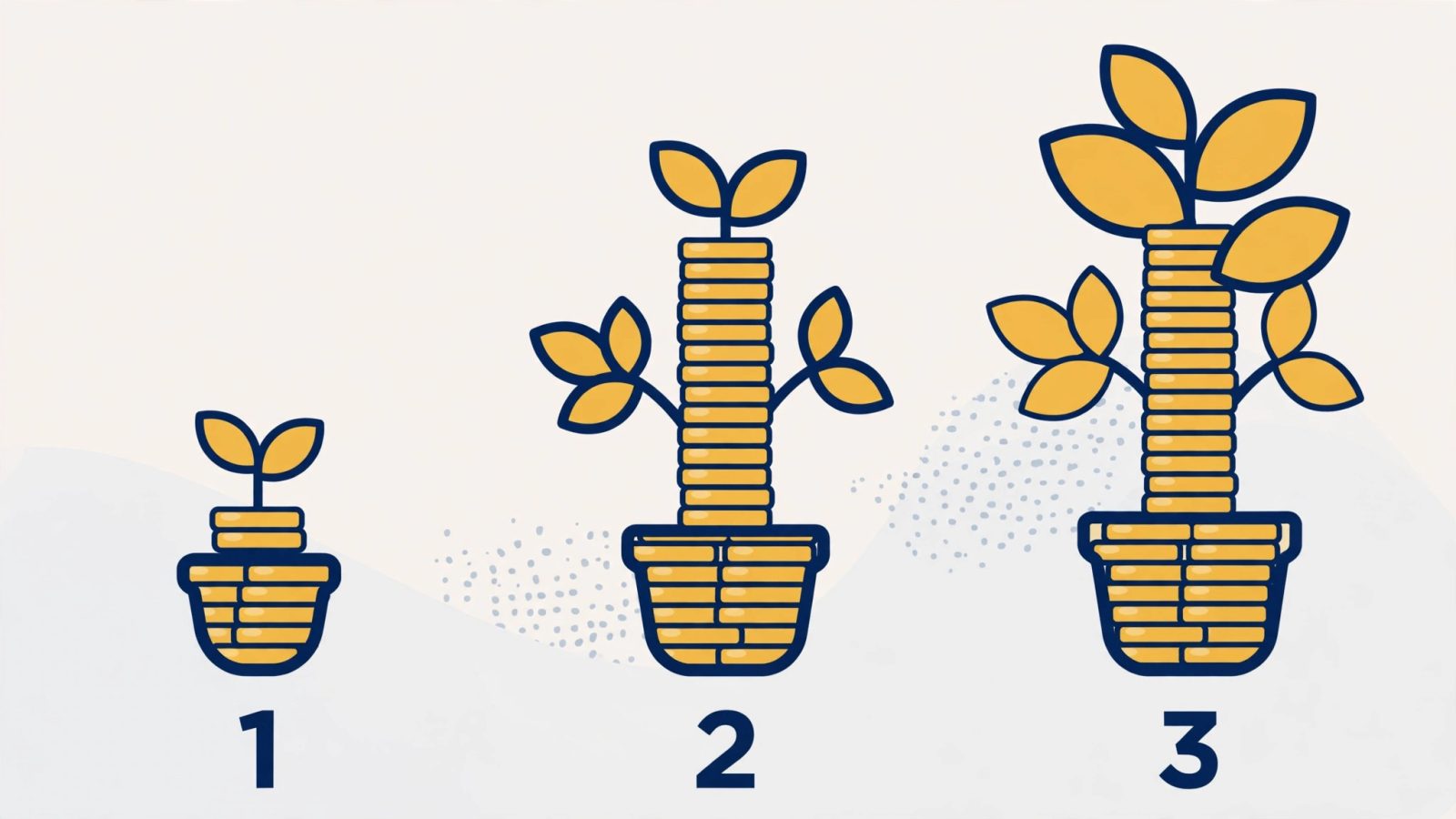
The part in brackets, (1 + r / n), is the growth in a single compounding period. The exponent, n x t, is the total number of periods. The exponent is where the power lives: it turns steady growth into exponential growth, which is why the balance rises slowly at first and then climbs faster and faster.
For regular monthly contributions, the formula extends with a second part for the payment stream, but the idea is identical: each deposit starts earning interest as soon as it lands, and that interest earns interest too. You do not need to work any of this out by hand. Our free Compound Interest Calculator runs the full formula for you, including monthly contributions and different compounding frequencies, so you can test your own scenario in seconds.
Simple Interest vs Compound Interest: The Same $10,000, Two Very Different Endings
Put $10,000 in an account paying 5% a year for 10 years. With simple interest, you earn $500 every year, because 5% of $10,000 is always $500. After 10 years you have $15,000: your $10,000 plus $5,000 of interest.
With compound interest at the same 5%, compounded once a year, you earn $500 in the first year, then 5% of $10,500 in the second year, then 5% of an even larger balance in the third, and so on. After 10 years you have $16,288.95. That is $1,288.95 more than simple interest, from the same deposit, the same rate and the same ten years. The only difference is that the interest was left in the account to earn more interest.
| Year | Simple interest balance | Compound interest balance |
|---|---|---|
| 1 | $10,500.00 | $10,500.00 |
| 2 | $11,000.00 | $11,025.00 |
| 3 | $11,500.00 | $11,576.25 |
| 4 | $12,000.00 | $12,155.06 |
| 5 | $12,500.00 | $12,762.82 |
| 10 | $15,000.00 | $16,288.95 |
Notice that the gap is zero in year one, $25 in year two, and $1,288.95 by year ten. The gap grows every year because the balance earning interest grows every year. Stretch the same example to 30 years and the difference becomes dramatic: simple interest gives you $25,000, while compound interest gives you $43,219.42. The lesson is the same one every example in this guide repeats: compounding rewards patience, and it punishes delay.
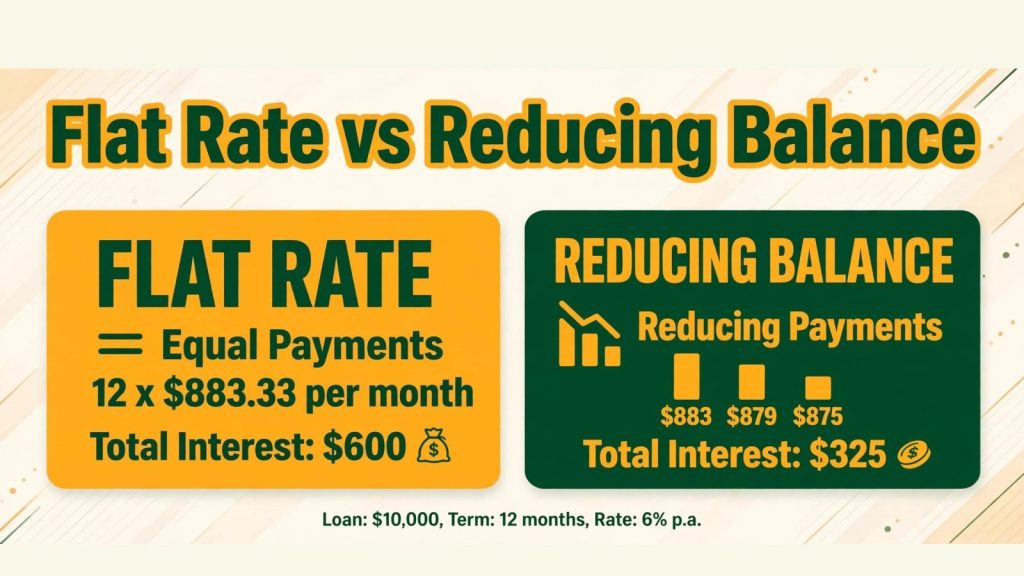
The same logic applies when you borrow. A loan that charges simple interest costs you the same amount of interest every year, while a loan that compounds charges interest on the growing balance. If you want to see how different loan structures change what you actually pay, our guide to flat rate vs reducing balance interest compares the real cost of the same 8% loan under two common methods.
How Often Interest Compounds Changes the Result
Compounding frequency is the n in the formula, and it matters. Take the same $10,000 at 6% for 10 years:
| Compounding | Final balance | Interest earned |
|---|---|---|
| Annually (n = 1) | $17,908.48 | $7,908.48 |
| Monthly (n = 12) | $18,193.97 | $8,193.97 |
| Daily (n = 365) | $18,220.29 | $8,220.29 |
Monthly compounding beats annual compounding by $285.49 on the same deposit, because the interest starts earning interest eleven extra times a year. Daily compounding beats monthly by only $26.32. The jump from annual to monthly is meaningful; the jump from monthly to daily is almost nothing. When you compare savings accounts, check the compounding frequency alongside the rate – a slightly lower rate with monthly compounding can beat a slightly higher rate that compounds once a year.
There is a limit to this effect. Even if interest were compounded continuously, every moment of every day, $10,000 at 6% for 10 years would reach about $18,221.19, barely above daily compounding. Frequency helps, but it is a small lever next to the two big ones: the rate, and above all, time.
Real Example 1: The Retirement Habit That Builds $1.7 Million

This is the compound interest example financial advisers cite most often, and it is worth seeing with exact numbers. A 25-year-old invests $500 every month into a retirement account earning an average 8% a year, compounded monthly, and keeps going until age 65. That is 40 years of contributions.
- Total contributed: $500 x 480 months = $240,000
- Final balance at 65: $1,745,504
- Growth from compounding: $1,505,504
More than 86% of the final balance is growth, not money the saver put in. The contributions were $240,000; compounding added over $1.5 million on top. And the growth is back-loaded: in the early years the balance grows slowly, because there is little in the account for interest to work on. In the final decade, the balance is so large that a single year of 8% growth adds more than an entire year of contributions.
Two honest notes. First, 8% is a planning figure, not a promise. The S&P 500 has compounded at about 10.0% a year with dividends reinvested from 1928 through 2025, according to the historical dataset maintained by NYU professor Aswath Damodaran, and about 6.8% a year after inflation. So 8% sits below the long-run nominal average, but any single 40-year stretch can be better or worse, and past performance never guarantees future results. Second, these figures are before tax and fees, which reduce what you keep. Even after allowing for both, the shape of the result does not change: steady contributions plus decades of compounding do the heavy lifting.
Real Example 2: Starting 10 Years Earlier More Than Doubles Your Money
Now compare two savers who both put aside $100 a month at 7% a year, compounded monthly, until age 65. The only difference is when they start.
- Sara starts at 25. She contributes for 40 years: $48,000 in total. She retires with $262,481.
- Tom starts at 35. He contributes for 30 years: $36,000 in total. He retires with $121,997.
Sara contributed only $12,000 more than Tom, but she ends up with $140,484 more – over twice as much. Those extra ten years at the start are worth far more than ten years at the end, because money contributed early gets forty years of compounding, while money contributed late gets far fewer. This is the single most useful fact in personal finance for anyone under 40: the best time to start was ten years ago, and the second-best time is today.
The same maths works at smaller amounts. Put $200 a month aside at 7% for 30 years and you end up with $243,994, from $72,000 of contributions. You do not need a large income to benefit from compounding. You need a habit, and you need to give it time.
Real Example 3: Credit Card Debt – Compound Interest Working Against You

Compound interest does not care whose side it is on. On a credit card it works for the lender, and it is the reason a balance can feel impossible to clear. Credit card interest compounds monthly, and often daily, on the unpaid balance – including interest charged in earlier months.
Take a $5,000 balance at 22.36% APR, the average rate on US credit card accounts that were actually assessed interest in August 2026, according to the Federal Reserve’s G.19 consumer credit release. The same release puts the average across all accounts at 21.19%, but the 22.36% figure is the one that describes people carrying a balance. Pay $130 a month and never charge another dollar:
- Time to clear the balance: about 68 months, or 5 years and 8 months
- Total paid: about $8,880
- Interest paid: about $3,880
You borrowed $5,000 and repaid nearly $8,880, because every month the unpaid balance, including the interest added last month, was charged interest again. In the early months most of the $130 payment goes to interest: at 22.36%, the first month’s interest alone is about $93. Only about $37 of the first payment reduces the balance. That is why minimum payments are a trap – they are designed to keep the balance alive so it can keep compounding.
The fix is the same maths in reverse. Pay $200 a month instead of $130 and the same $5,000 balance clears in about 34 months, with total interest of about $1,800 instead of $3,880. Every extra dollar you pay now is a dollar that stops compounding against you for years. If you carry a balance, pay more than the minimum whenever you can, and stop adding new charges until the balance is gone.
Real Example 4: A Certificate of Deposit and a Student Loan
Compounding shows up in the most ordinary financial products. Suppose you deposit $3,000 in a certificate of deposit paying 6% a year, compounded monthly, and leave it untouched for 20 years. The balance grows to $9,930.61. You more than tripled your money by doing nothing at all – the interest did the work, quietly, month after month.
Now the other side. A $35,000 student loan at 5.5% on a standard 10-year repayment plan costs about $380 a month. Over the ten years you repay about $45,580 in total, so the interest is about $10,580. Stretch the same loan over 25 years with a lower monthly payment and the total interest nearly triples, to about $29,500, even though the amount borrowed never changed. A longer term feels easier month to month, but compounding charges you for every extra year the balance stays alive.
The pattern is always the same. When you are the saver, you want the longest time horizon and the highest compounding frequency you can get. When you are the borrower, you want the shortest term and the fastest payoff you can afford. Time is the variable that decides which side of compound interest you end up on.
The Rule of 72: Doubling Time in Your Head
There is a shortcut the US Securities and Exchange Commission teaches on its Investor.gov education pages: divide 72 by the annual interest rate, and the answer is roughly how many years it takes your money to double. At 6%, money doubles in about 12 years. At 8%, about 9 years. At 10%, about 7 years.
The rule is remarkably accurate near the rates people actually earn. At 8%, the rule says 9 years, and the exact answer is 9.01 years. At 3% the rule says 24 years against an exact 23.45 years, and at 12% it says 6 years against an exact 6.12. It is most accurate near 8%, but it is close enough anywhere in the normal range to be useful in a conversation, a meeting, or a quick decision.
Use it to compare choices in seconds. A savings account at 4% doubles your money in 18 years; an investment averaging 8% doubles it in 9. That single comparison explains why the rate matters, and why leaving money in an account paying almost nothing is so expensive over a lifetime. It also works in reverse: a credit card at 24% doubles a balance left untouched in about 3 years. The rule of 72 turns an abstract rate into a time you can feel.
How to Make Compound Interest Work for You
Knowing the formula is not enough. Compounding only helps if you set it up and leave it alone, so here is a practical routine that uses everything in this guide.
- Start now, even with a small amount. As the Sara and Tom example showed, ten years at the start is worth more than a larger amount later. $100 a month started today beats $200 a month started in ten years.
- Automate the contribution. A monthly transfer on payday removes willpower from the decision. The money compounds whether you think about it or not, and you never miss a month.
- Never withdraw the interest. The moment you take the interest out and spend it, you have turned compound interest back into simple interest. Reinvest every payment, including dividends, and let the balance keep growing.
- Choose the highest rate you can get safely. Compare savings accounts on the rate and the compounding frequency together. A high-yield savings account that compounds monthly beats a standard account by a real margin over ten years.
- Raise the contribution when your income rises. A $50 monthly increase, kept for 30 years at 7%, adds about $61,000 to the final balance. Small raises compound just like small deposits do.
- Check your own numbers. Before you commit to a plan, run it through our free Compound Interest Calculator and change the rate, the monthly amount and the number of years. Seeing your own figures is far more convincing than reading someone else’s example.
Common Mistakes That Kill Compounding
Compounding is simple, but it is easy to break. The most common mistakes are all versions of the same error: interrupting the process.
- Waiting for the perfect moment. People wait for a pay rise, a bonus, or a calmer year. Every year of waiting costs far more than a slightly larger deposit later, because the early years compound the longest.
- Cashing out on a dip. Markets fall, and selling during a fall locks in the loss and removes the balance that would have compounded the recovery. The long-run average already includes every crash in the last hundred years.
- Paying only the minimum on a card. As the credit card example showed, minimum payments keep a balance compounding against you for years. The interest you pay is the return someone else earns.
- Ignoring fees and tax. A 1% annual fee sounds small, but over 30 years it takes a large bite out of the final balance. Check the fees on any account, and remember that interest in an ordinary savings account is usually taxed in the year it is earned.
- Chasing the highest rate every month. Moving money constantly to chase a slightly better rate usually costs more in lost compounding time and hassle than it gains. Pick a good account and stay put.
Frequently Asked Questions
Is compound interest better than simple interest? For saving, yes, always: compound interest pays interest on your interest, so the balance grows faster every year. For borrowing, simple interest is cheaper, because the interest never starts earning interest of its own.
How much will $10,000 grow to in 20 years at 7%? With annual compounding, $10,000 at 7% becomes $38,696.84 in 20 years. With monthly compounding it becomes $40,387.39. The difference is the extra compounding periods doing their quiet work.
Can compound interest make me rich? It can build serious wealth from ordinary contributions, as the $500-a-month example showed, but it needs decades, a reasonable return and regular contributions. Anyone promising to make you rich quickly with compounding is selling something.
Does compound interest work with monthly deposits? Yes, and monthly deposits are where it shines. Each deposit starts compounding the month it lands, so a steady monthly habit benefits from decades of overlapping growth.
What is the difference between APR and APY? APR is the annual rate before compounding, while APY is the effective yearly rate after compounding is included. A 7% rate compounded monthly has an APY of 7.23%, because each month’s interest starts earning interest too. Banks disclose APY so you can compare accounts fairly.
Compound interest is not a trick and it is not magic. It is a simple rule – interest earns interest – repeated thousands of times over years and decades. Used well, it turns a $100 monthly habit into a six-figure sum and a $500 monthly habit into more than $1.7 million. Used badly, it turns a $5,000 card balance into nearly $8,880 of repayments. The maths is identical either way. The only choice is which side of it you stand on, and the best day to choose was years ago. The second-best day is today. Run your own numbers on our free Compound Interest Calculator and see what your money could become.
Sources and checking: figures in this article were checked on 14 November 2026 against the Federal Reserve G.19 consumer credit release (average credit card APR 22.36% on accounts assessed interest, August 2026), the NYU Stern (Damodaran) historical returns dataset (S&P 500 compound annual total return about 10.0% from 1928 through 2025, about 6.8% after inflation), and the SEC Investor.gov guidance on the rule of 72. All worked examples were calculated from the compound interest formula. This article is educational and is not investment advice.